
Fauna Spotters H5 Bird Flu Response Protocol.
As of 17 September 2026, Australia has 576 confirmed events of H5 high pathogenicity avian influenza (H5 bird flu) in wildlife across Western Australia, South Australia, New South Wales, Queensland, Victoria and Tasmania. Detections so far are in wildlife only, with no cases in Australian poultry or the wider agricultural system. This page sets out how Fauna Spotters is responding, and what we ask of clients, principals and site managers.
Important warning to clients and site managers
Please do not allow your own staff, contractors, or the public to handle sick, injured, or dead birds or mammals on your sites during this period. This includes moving carcasses out of the works path, collecting them for disposal, or gathering them for identification.
H5 bird flu is a serious animal disease and a recognised human health risk in unprotected exposure. Handling must be left to Fauna Spotters personnel who are trained, equipped with full hazmat PPE, and working under a documented biosecurity procedure. If a sick or dead animal is discovered on your site, stop works in the immediate area, keep people and pets away, and contact Fauna Spotters. We will attend, assess, handle, and decontaminate under the protocol below.
Why this matters
Australia's H5 bird flu incursion is recent and still developing. First wildlife detections in wild seabirds were confirmed in June 2026, first detections in mammals were confirmed in August 2026, and evidence of local transmission between wild birds has now been documented in Victoria and South Australia. H5 bird flu is expected to remain an ongoing wildlife disease in Australia.
The virus has demonstrated a wide host range. In Australia, detections so far have been in wildlife only — mostly wild birds, together with a small number of marine and terrestrial mammals. Internationally, clade 2.3.4.4b H5N1 has infected wild and domestic birds, wild carnivorous mammals, marine mammals, domestic cats and dogs, dairy cattle and other species. The vast majority of human A(H5) cases since 2021 have been linked to direct or indirect contact with infected animals or contaminated environments, with no sustained human-to-human transmission identified.
Every unprotected human contact with an infected animal or contaminated environment is a chance for the virus to spread further and to adapt. That is why we treat every suspect animal as a hazmat wildlife handling task and ask all site personnel to keep well clear. The precautions on this page are proportionate to the risk this virus already presents and to what it could still become.
Our operational reality
Fauna Spotters is engaged to keep construction, clearing, maintenance and emergency works moving safely. When a sick, injured or dead animal is in the works path, our spotters are the people who move it. We are not walking away from that responsibility. Instead we treat every such encounter under H5 bird flu conditions as a hazmat wildlife handling task, with strict PPE, controlled handling and full decontamination before the crew returns to work.
We follow the national AVOID. RECORD. REPORT. principle for wildlife the works do not require us to touch, and apply the full hazmat protocol below whenever handling is unavoidable.
Mandatory PPE for handling suspect wildlife
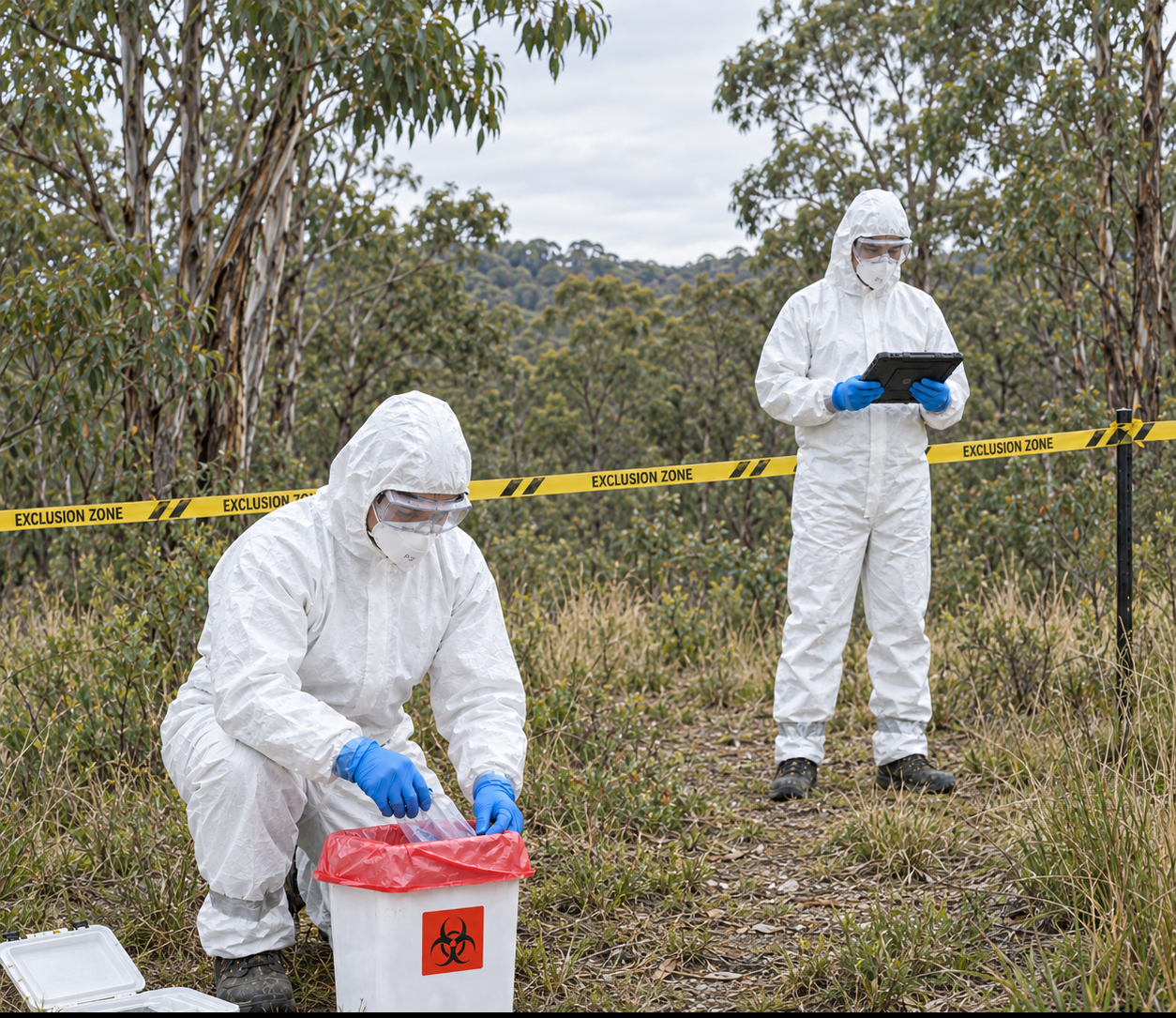
Every Fauna Spotters vehicle carries a sealed H5 handling kit. Before any spotter approaches a sick or dead bird or mammal in the works area, they don, in order:
- Respiratory — fit-tested P2/N95 respirator, or a P3/half-face respirator with P3 filters for prolonged handling or mass mortality events.
- Eye protection — sealed safety goggles or a full face shield worn over the respirator.
- Body — Category 3 Type 4/5/6 disposable coverall with attached hood, seams taped at wrist and ankle cuffs.
- Hands — double nitrile gloves, minimum 6 mil, outer glove taped to the coverall cuff.
- Feet — disposable overboots or dedicated rubber boots that stay with the affected site.
- Head — disposable hood in addition to the coverall hood where splash or feather-dust risk is high.
Two-person handling rule
No spotter handles suspect wildlife alone. A second person acts as a clean spotter, manages the site perimeter, films the process for the audit trail, and does not enter the contaminated zone.
Handling procedure for sick, injured or dead wildlife in the works path
1. Stop works in the immediate area and establish a marked exclusion zone around the animal.
2. Notify the site supervisor and the client representative. Where circumstances allow, we call the Emergency Animal Disease Hotline on 1800 675 888 for direction before handling, and record the case reference.
3. Don full PPE at a clean staging point upwind of the animal, buddy-checked before entry.
4. Record GPS, species, number, condition and photos through the Fauna Spotters field app before any contact.
5. Sick or injured animals are handled under permit conditions, contained in a lined, sealable transport container, and moved only as far as needed to clear the works or to an agreed veterinary or authority handover point. Euthanasia, where required, follows our existing animal welfare procedure and permit conditions.
6. Dead animals are double-bagged in heavy-duty biohazard bags, the outer bag wiped down, sealed, labelled with date, site, species and spotter, and held in a dedicated sealed container.
7. Disposal follows the direction of the state biosecurity agency. Default is on-site deep burial where permitted, or transfer to an approved facility. Carcasses are not moved off site without authority sign-off where the site is under investigation.
Decontamination before returning to works
Decontamination happens at a designated dirty-to-clean line before any spotter re-enters the general work area:
- Outer gloves, coveralls, overboots, hood and eye protection removed in a controlled doffing sequence into a lined biohazard bin, respirator removed last.
- Reusable equipment (grabs, hooks, containers, boots, torches) washed of organic matter, then disinfected with an agent effective against avian influenza at label contact time. Virkon S, sodium hypochlorite at 1000 ppm available chlorine, or an equivalent APVMA-registered disinfectant is used.
- Vehicle tyres, wheel arches, cargo area, and any tools that contacted the animal or its container are washed and disinfected before leaving site.
- Hands and forearms washed with soap and water, then alcohol-based hand rub.
- Clothing worn under PPE bagged for hot-wash laundering. Contaminated single-use PPE is treated as clinical waste.
- Between properties, and between separate work zones on the same property where a detection is suspected, we repeat vehicle and equipment decontamination so we do not carry virus onto a clean site.
Human health and fitness for work
Any spotter who has handled suspect wildlife is logged, monitored for flu-like symptoms for 10 days, and stood down immediately at first sign of illness with instruction to seek medical advice and disclose the wildlife exposure. Our existing zero-BAC, fatigue and medication rules continue to apply. We ask clients to apply the same standard to any of their own staff who may have had unprotected contact with a suspect animal before Fauna Spotters arrived.
Working with clients
Fauna Spotters remains fully operational and available for scheduled and emergency works. On every project we will:
- Brief crews on H5 bird flu status and the handling protocol before mobilisation.
- Carry the H5 handling kit on every vehicle.
- Record and report every handled case to the client and, where required, to the state biosecurity agency leading the on-ground response.
- Provide location records, species lists, photos and disposal evidence if your site is drawn into a National Management Agreement response.
Sources and further reading
We monitor updates from birdflu.gov.au, Wildlife Health Australia and the relevant state biosecurity agency for every project location, and revise this procedure as the national situation develops.
- Australian Government national dashboard: https://www.agriculture.gov.au/campaigns/birdflu
- Wildlife Health Australia incident page: https://wildlifehealthaustralia.com.au/Incidents/Incident-Information/incident-h5n1-high-pathogenicity-avian-influenza-h5-bird-flu-in-wildlife-australia-ongoing
- FAO/WHO/WOAH joint public health assessment (April 2025): https://www.woah.org/app/uploads/2025/04/2025-04-17-fao-woah-who-h5n1-assessment.pdf
- Emergency Animal Disease Hotline: 1800 675 888
Downloads
Print or share these on site. All PDFs sourced from official Australian Government material.
- Keep watch for bird flu — workplace poster — Print-ready A3 poster for site sheds, depots and staff areas. (Australian Government — DAFF)
- H5 bird flu and nature — public information poster — Overview of how H5 bird flu affects Australian wildlife and what to do if you find a sick or dead animal. (Australian Government — DAFF)
- Stay safe from bird flu — fact sheet — Personal safety and human health information for anyone who may encounter sick or dead wildlife. (Australian Government — DAFF)
- How H5 bird flu can impact our wildlife — Background on the disease, at-risk species and the national response. (Australian Government — DAFF)
- Checklist for disposing of dead wildlife — Quick-reference checklist covering safe handling and disposal steps. (Australian Government — DAFF)
- Public guidance on disposal of dead wildlife — Detailed public guidance on safely disposing of dead wildlife during the H5 incursion. (Australian Government — DAFF)
- National principles for wildlife carcass management — The national principles the state biosecurity agencies apply to wildlife carcass management. (Australian Government — DAFF)
Frequently asked questions
Is Fauna Spotters still operating during the H5 bird flu incursion?
Yes. Fauna Spotters is fully operational for scheduled and emergency works. Every project runs under our H5 handling protocol, with full PPE and decontamination when a suspect animal is in the works path.
Can our own staff move a sick or dead bird if it is holding up the works?
Please don't. Stop works in that immediate area, keep people and pets away, and contact Fauna Spotters. We will attend, handle and decontaminate under this protocol. Unprotected handling is a serious biosecurity and human-health risk.
Has H5 bird flu been detected in Australian farm animals?
No. All Australian detections to date have been in wildlife — mostly wild birds together with a small number of marine and terrestrial mammals. There are no detections in Australian poultry or the wider agricultural system. Overseas, the virus has infected dairy cattle and other farm species, which is why keeping unprotected people, livestock and pets away from suspect wildlife matters so much right now.
Who should we call if we find a sick or dead bird outside a Fauna Spotters project?
Australia's 24-hour Emergency Animal Disease Hotline on 1800 675 888. Avoid the animal, record the location, and report it.